
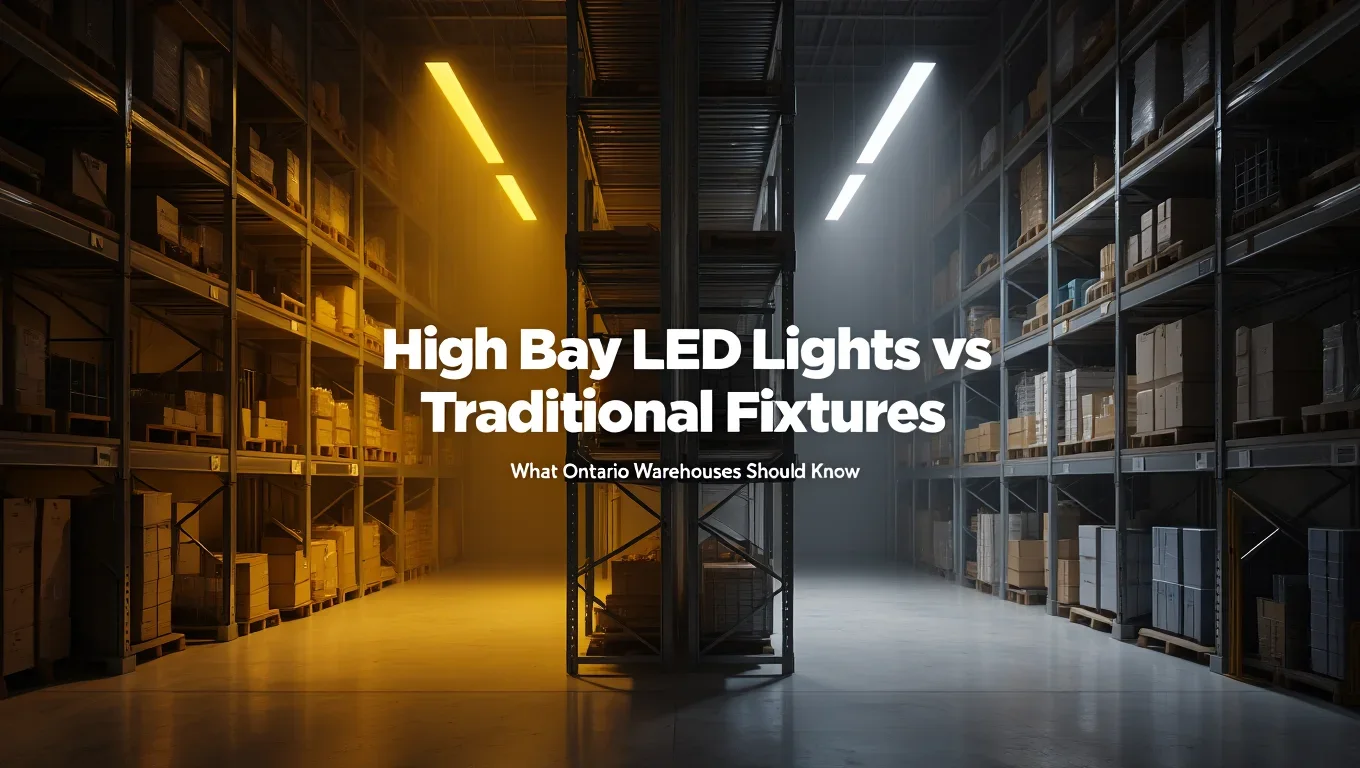
If your warehouse is still running on metal halide or high-pressure sodium fixtures, you already know something isn’t right. The bills are high. Maintenance keeps coming back around. And the light quality, if you’re honest about it, isn’t what a modern operation needs.
The case for switching to LED high bays isn’t complicated. You draw less power, spend less on upkeep, and get better light doing it. In Ontario, where commercial hydro rates are structured in a way that punishes high consumption at multiple levels, the numbers move faster than most facility managers expect.
This article covers what the actual difference looks like in terms of technology, costs, Ontario-specific considerations, and how to think about the timing of an upgrade.
What Are High Bay LED Lights?
High bay lights are fixtures designed for tall spaces, for ceilings between 20 and 45 feet. That covers most warehouses, distribution centres, manufacturing floors, and aviation hangars. Spaces where standard commercial fixtures stop being useful.
The issue is straightforward. Light loses intensity over distance. A fixture built for a 12-foot ceiling doesn’t have the output to push consistent illumination across 35 feet of vertical space. What reaches the floor is unevenly bright under the fixture, dim in between. In an office, that’s a minor issue. In a facility with forklift traffic and active inventory operations, uneven lighting is a safety and accuracy problem.
High bay LED fixtures are built to close that gap. Enough intensity at the source, focused in the right direction, so that floor-level coverage is consistent rather than patchy. That’s the whole point of them, and in any space with serious ceiling clearance, no other category of fixture reliably does that job.
Key Features of LED High Bay Lights
Three things define what makes LED high bays different from what they’re replacing:
- High lumen output. These fixtures produce intense, focused light that reaches floor level without scattering or losing usable intensity. The beam arrives with enough strength to actually illuminate work-level activity properly.
- Energy efficiency. LED high bays typically use 60 to 80% less electricity than equivalent metal halide or high-pressure sodium fixtures. That’s not a marginal improvement, it’s cutting your lighting energy draw by more than half while delivering better light quality.
- Long lifespan. Quality LED fixtures are rated for over 100,000 hours. That’s the practical difference between solid-state technology and traditional lamp-and-ballast assemblies that degrade steadily from the day they’re installed.
Traditional Warehouse Lighting Fixtures Explained
Common Types
Three technologies have run Ontario warehouses for the better part of four decades:
- Metal halide was the go-to traditional warehouse lighting for high-ceiling industrial spaces. It produces bright, white light and was genuinely effective for its era. Most Ontario warehouses built before 2010 are still running on it.
- Fluorescent T5/T8 fixtures work in lower-clearance spaces and are more efficient than HID alternatives. But they’re fragile, contain mercury, and perform poorly in cold environments.
- High-pressure sodium lamps prioritize output over colour quality. The yellow-orange light they produce gets the job done in rough industrial settings, but it makes reading labels and identifying inventory accurately harder than it needs to be.
Limitations of Traditional Fixtures
The issues with these systems are practical. If you evaluate metal halide vs LED, you will notice difference in :
- Warm-up time. Metal halide fixtures take 10 to 15 minutes to reach full brightness. That makes occupancy sensors completely impractical. You either leave lights running in empty zones or wait in the dark each time someone enters a space.
- Energy waste. A 400W metal halide draws closer to 458W once ballast inefficiencies are factored in. A significant portion of that draw becomes heat, not light. You’re paying for power that never reaches your workspace.
- Maintenance overhead. In a high-bay facility, replacing a single fixture means clearing floor space, renting a scissor lift, sourcing the right parts, and pulling someone off other work. Across dozens of fixtures in a large warehouse, that cycle is ongoing and expensive.
High Bay LED Lights vs Traditional Fixtures: Key Differences
In the debate of LED vs metal halide lighting, the advantages of upgrading extend far beyond simple illumination. Here is how:
#1. Energy Efficiency
A 400W metal halide draws around 458W at the wall. An LED fixture producing equivalent or better illumination draws 120W to 150W. That’s a 65 to 70% reduction per fixture.
In a mid-sized Ontario warehouse running dozens of fixtures on a standard operating schedule, that difference is tens of thousands of dollars annually. Ontario’s commercial hydro pricing includes the Global Adjustment fee and peak demand charges, which means reducing your lighting load has a compounding effect on your bill, it’s not just kilowatt-hours that drop.
#2. Lifespan and Maintenance
Metal halide bulbs are rated for roughly 15,000 hours, but lumen depreciation means usable output often drops to half well before they fail. You’re running a system at full electricity cost while getting significantly degraded light.
LED fixtures operate for 100,000+ hours with slower degradation and are considered an energy-efficient warehouse lighting. Every avoided replacement cycle means one less lift rental, one less production disruption, one less maintenance callout. That adds up across the life of the system in a way that’s easy to undervalue when you’re looking only at fixture cost.
#3. Light Quality and Performance
Lumens measure output. CRI, Colour Rendering Index measures how accurately a light source renders colours against natural daylight. Metal halide sits around 65 to 75 CRI. High-pressure sodium is in the 20s. Commercial LED fixtures typically run 80 to 90.
In practice, workers under LED lighting read labels more accurately, identify inventory by colour more reliably, and experience less eye strain over long shifts. In environments with forklift traffic and narrow aisles, visibility directly affects safety and error rates, it’s not a minor quality-of-life improvement.
#4. Installation and Compatibility
The transition from traditional to LED is more straightforward than most facility managers expect. If your existing fixture housings are structurally intact, LED retrofit kits drop into them with the same wiring, same mounting and significantly lower installation cost. Full replacements are designed to integrate with standard industrial electrical infrastructure without major rewiring.
Either path is well understood at this point and less disruptive than the scale of the upgrade might suggest.
#5. Environmental Impact
LED fixtures contain no mercury, no pressurized gases, and no hazardous materials. Traditional fluorescent tubes and HID lamps do, which creates disposal obligations LEDs don’t carry. The energy reduction also cuts your facility’s carbon output proportionally, measurable and documentable if you’re working toward sustainability targets or green certifications.
#6. Cost Comparison: Upfront vs Long-Term Savings
Initial Investment
LED fixtures cost more upfront than a replacement metal halide bulb and ballast. That’s straightforward. But the relevant comparison isn’t fixture cost versus bulb cost, it’s the total cost of keeping a traditional system running over the next decade versus absorbing a one-time capital event now.
Replacing a failing component in a legacy system extends an infrastructure that will keep demanding maintenance, consuming excess energy, and eventually requiring the same capital conversion just later, with more accumulated cost in the meantime.
Operational Savings
Savings from switching arrive immediately across two channels. Electricity costs drop in proportion to the wattage reduction typically 60 to 80% of your lighting-related energy spend. When calculating your high bay lighting cost savings, maintenance costs drop sharply because a 100,000-hour system doesn’t need the same ongoing attention. Both reductions are ongoing. Every month you’re running the new system, you’re spending less than you would have on the old one.
ROI and Payback Period
For most Ontario industrial facilities, the payback period lies between 1.5 and 3 years, depending on fixture count, operating hours, local hydro rate, and the rebates you actually receive. LED ROI in warehouse facilities is typically achieved within 2–3 years. Ontario’s hydro pricing structure presents Global Adjustment plus peak demand charges tends to accelerate that timeline compared to simpler electricity markets. Once the investment is recovered, the savings flow directly to the bottom line for the remaining life of the system.
Ontario-Specific Considerations for Warehouse Lighting
- Energy Rebates & Incentives
Ontario’s energy efficiency landscape offers significant financial support for businesses upgrading their warehouse lighting in Ontario facilities. The Independent Electricity System Operator (IESO) Save on Energy retrofit program, alongside local utility incentives, provides businesses with rebates that can offset equipment and installation costs by up to 50%. Both prescriptive and custom rebate streams are available, substantially shortening your payback period when properly leveraged.
- Compliance & Safety Standards
For operators managing industrial lighting in Canada facilities, compliance with the Occupational Health and Safety Act (OHSA) is a non-negotiable legal obligation. Regulated illumination standards exist specifically to reduce accidents in high-risk zones like loading docks, narrow aisles, and forklift traffic areas. High-bay LED upgrades deliver uniform, shadow-free light that meets or exceeds provincial lux and foot-candle requirements, keeping your facility compliant and your workforce protected.
- Climate Considerations
Ontario winters pose a real operational challenge for unheated or semi-heated warehouses. Fluorescent tubes are known to struggle at low temperatures, slow to start and prone to significant lumen loss in the cold. LED technology performs differently: built on solid-state electronics rather than temperature-sensitive gases, LEDs power on instantly at full brightness regardless of conditions. For any warehouse lighting in Ontario operating through harsh winters, this translates to consistent, reliable illumination year-round.
When Should You Upgrade to High Bay LED Lights?
Waiting for a traditional fixture to completely fail before replacing it is one of the more expensive habits in warehouse management. The system rarely breaks in a single clean moment; rather, it degrades slowly, costs quiet, and by the time the problem is visible, you’ve already been absorbing the consequences for longer than you realise. Knowing what to look for earlier makes the decision easier and the timing better.
Flickering or cycling fixtures.
Flickering isn’t a maintenance footnote. It’s a ballast that’s already on its way out. The fixture will need replacing whether you act now or later. The difference is that acting now means doing it on your timeline, with a planned lift rental and a cleared schedule. Waiting means dealing with it reactively, often mid-operation, and usually at a less convenient moment than you’d choose. In the meantime, the visual disturbance affects everyone working in that zone for as long as the issue goes unaddressed.
Climbing hydro bills without explanation.
Traditional fixtures become less efficient over time, drawing consistent power while delivering declining output. The change is gradual enough that it doesn’t trigger any single alarm, it just adds cost month after month until it becomes a pattern nobody has explained. If your electricity spend has been trending upward and you haven’t significantly changed your operations, lighting load is one of the first things worth auditing. The inefficiency has likely been building longer than the billing trend suggests.
Areas of the floor that are visibly dim.
Lumen depreciation doesn’t announce itself. It happens slowly enough that people adjust to it, working in zones that are dimmer than they should be without necessarily flagging it as a problem. But when sections of your warehouse are producing noticeably less light than your layout requires, particularly near loading docks, in racking aisles, or in areas with active equipment. You’ve crossed from inconvenience into a safety concern. The standard hasn’t changed. The output has.
Ideal Scenarios for an LED Retrofit
Beyond fixing failing hardware, strategic business shifts provide perfect opportunities to upgrade:
Expanding Your Warehouse
Expanding your footprint or reconfiguring racking is a natural moment to address lighting at the same time, rather than working around an existing layout.
Targeting Sustainability Goals
For facilities pursuing sustainability targets or ESG reporting requirements, LED lighting is one of the cleaner improvements available, the before-and-after energy numbers are clear and documentable.
How to Choose the Right High Bay LED Lights
Navigating your high bay lighting selection requires more than simply buying the brightest fixture on the market. Consider this your essential LED warehouse lighting guide: to achieve maximum efficiency and safety, you must strictly match the fixture’s specifications to your facility’s unique architectural layout.
Choosing the right high bay lighting selection isn’t about wattage alone. The fixture must match your facility’s layout, ceiling height, and operational needs to deliver real efficiency and safety gains. Here is what is included in an LED warehouse lighting guide:
Key Factors to Consider
#1. Ceiling height determines wattage and beam angle. The higher the ceiling, the more focused the beam needs to be to deliver adequate floor-level illumination.
#2. Specify lumens, not watts. Lumens tell you how much light is produced. A photometric layout showing predicted foot-candle levels at floor height gives you something measurable to evaluate a proposal against wattage specs.
#3. Beam angle. Wide angles (90° to 120°) work for open floor plans. Narrow angles (60° or less) are needed for tall, tight racking aisles where light needs to travel vertically without spreading sideways.
#4. Motion sensors let fixtures dim or switch off in unoccupied zones, practical with LEDs in a way it never was with metal halide.
#5. Dimming capability. 0-10V dimmable fixtures allow output adjustment by shift timing, daylight, or zone requirements, compounding your base efficiency gains.
#6. Smart lighting controls enable automated scheduling, real-time consumption monitoring, and remote zone management, straightforward to integrate during installation and worth building into the initial scope.
Conclusion
The case for switching from traditional fixtures to LED rests on three things that are all true at once: lower energy costs from day one, dramatically less maintenance overhead, and better light quality that has real implications for safety and productivity in active industrial environments.
The financial argument is grounded in arithmetic. You draw less power per fixture, pay for replacements far less often, and in Ontario, you do both in a hydro environment that makes the savings larger than in most other markets. Provincial rebates reduce the upfront cost further. The transition itself is less complicated than it sounds.
If your current fixtures are aging, cycling, or driving maintenance costs that are hard to justify, the case for upgrading is straightforward. The technology is proven, the financials are predictable, and the operational improvements are immediate from the day the new system goes live.