
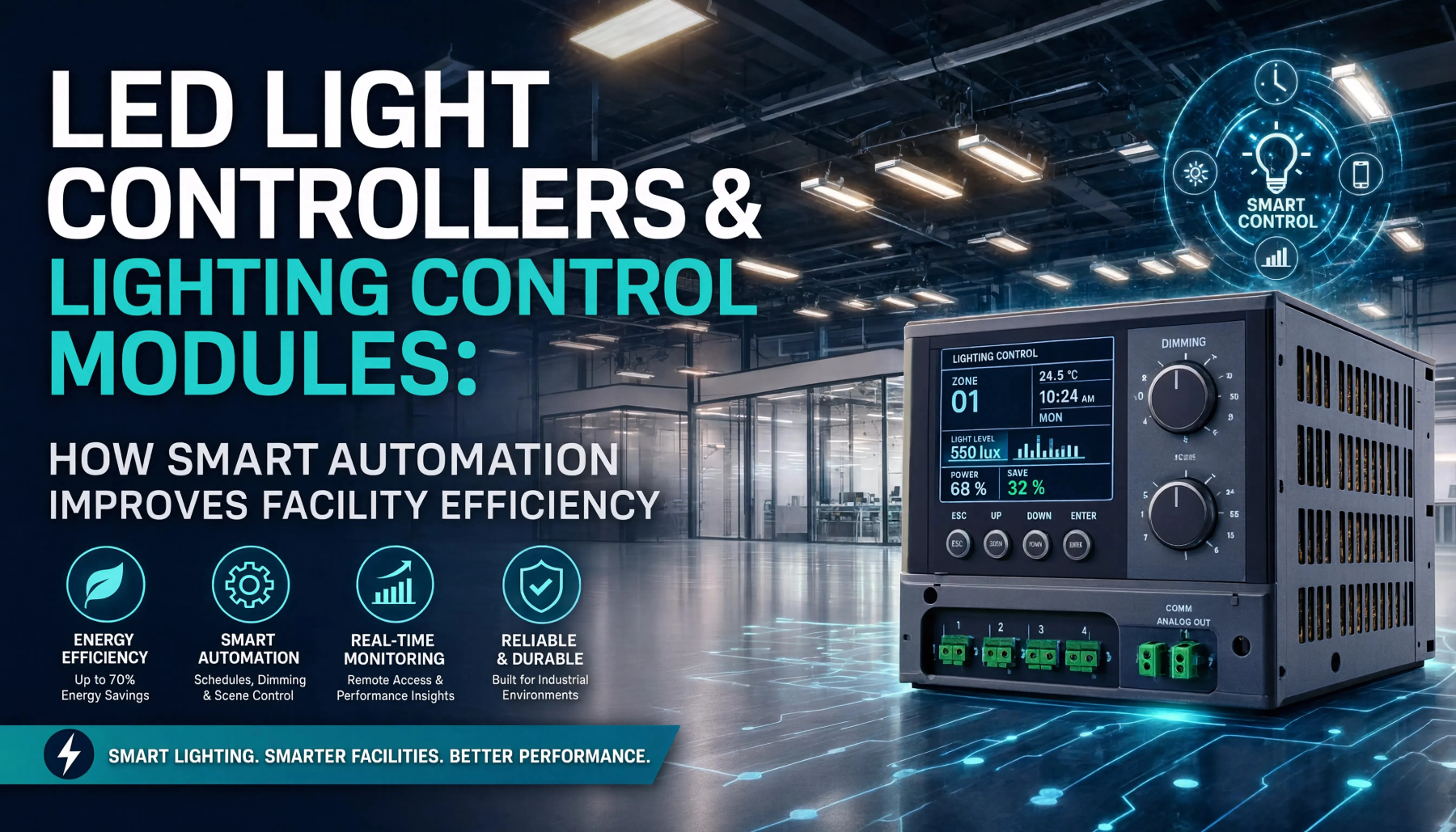
As organizations face increasing pressure to optimize operational expenses and minimize their ecological footprint, the transition toward energy-efficient facility management has become a critical priority. Today’s industrial and commercial sectors are rapidly abandoning traditional, static setups in favor of adaptable high-performance infrastructure. Central to this transformation are LED Light Controllers and Lighting Control Modules, which provide the essential intelligence required for sophisticated, modern illumination oversight.
Moving beyond basic manual operations to integrate smart lighting control systems allows administrators to achieve superior LED lighting automation. This evolution does not merely reduce power waste; it fosters a more productive workspace through customized environmental settings, supports ambitious ESG goals, and ensures significant financial returns through long-term utility savings.
This guide examines the primary roles of sophisticated modules and controllers, highlights the automated capabilities that drive facility efficiency, and discusses the strategic advantages of implementing an interconnected, intelligent lighting network.
What Are LED Light Controllers?
An LED Light Controller serves as the strategic heart of industrial and commercial illumination, acting as the intelligent “brain” that oversees all lighting activity. Moving beyond simple toggle operations, these advanced units process complex data to actively regulate light intensity via precision dimming, manage intricate schedules, and monitor energy use. By converting user directives or sensor-driven inputs into precise electrical signals, an LED controller system maximizes power economy while sustaining the perfect environmental conditions.
-
Key Components of an LED Lighting Control System
To reach peak facility efficiency, a high-performing network utilizes several integrated hardware and software elements:
-
Controllers:
The core processing units that interpret data, manage commands, and adjust power flow to fixtures or specific facility zones. -
Sensors:
Crucial devices, including motion detectors and daylight harvesting photocells, that provide real-time environmental metrics to the system. -
Timers:
High-precision digital clocks that activate automated lighting schedules based on facility shift patterns or standard operational hours. -
Communication Interfaces:
The specialized protocols, including DALI, 0-10V, or wireless standards, that facilitate seamless data exchange between all networked components.
-
Types of LED Light Controllers
To satisfy diverse infrastructure demands, LED lighting controls are typically implemented through several established hardware configurations:
-
Wired Controllers
These systems utilize dedicated physical cabling, such as Ethernet, to provide high-reliability, interference-free performance in new facility builds. -
Wireless Controllers
Utilizing advanced protocols like Zigbee or Bluetooth Mesh, these are the preferred choice for retrofitting existing spaces without complex wiring. -
Smart Networked Controllers
Fully interconnected platforms that integrate with building management software, enabling managers to oversee enterprise lighting from one central interface. -
Programmable LED Controllers
These sophisticated intelligent lighting controls allow for the creation of complex lighting scenes and automated demand-response profiles based on specific operational goals.
Understanding Lighting Control Modules
While individual light controllers act as localized brains, a Lighting Control Module (LCM) serves as the central nervous system of an enterprise-level illumination network. An LCM is a hardware routing device designed to distribute power, relay commands, and manage data across multiple fixtures, zones, or entire floors. Its primary purpose is to simplify installation and provide a centralized point of management for complex commercial lighting controls.
How Lighting Control Modules Work
A lighting control module bridges the gap between physical light fixtures and software-driven automation platforms.
- Data Routing: The module receives high-level commands from a building management system (BMS) or central dashboard and translates them into localized protocols (such as DALI, 0-10V, or wireless signals) to control specific lighting circuits.
- Sensor Integration: External inputs from occupancy sensors, photocells, and wall switches plug directly into the LCM. The module processes these inputs simultaneously, executing immediate, coordinated adjustments such as dimming an entire row of fixtures when daylight harvesting is triggered.
- Power Distribution: Beyond data, many modern smart lighting modules act as structured power centers, allowing multiple circuits to be safely managed from a single enclosure.
LED Light Controllers vs. Lighting Control Modules
Understanding automated lighting systems requires distinguishing between these two critical components:
- LED Light Controllers are typically fixture-specific or zone-specific. They handle the immediate electrical execution, such as modulating the current to dim a specific LED driver or tuning its color temperature.
- Lighting Control Modules operate at a higher network level. They do not replace controllers; instead, they aggregate and command them.
In a smart building ecosystem, they work in tandem: the central automation platform sends a command to the lighting automation module, which interprets the data and routes it to the specific LED light controllers assigned to that space. This layered architecture ensures maximum scalability, flexibility, and operational efficiency across large facilities.
Why Facilities Are Adopting Smart LED Lighting Automation
The global push toward modern facility management is driving a rapid transition from traditional illumination to smart lighting control systems. As organizations face increasing pressure to optimize resources, static lighting has become an operational liability. Today, facilities are aggressively adopting automated lighting solutions to address economic, operational, and regulatory demands.
Rising Energy Costs and Sustainability Goals
Lighting typically accounts for a significant portion of a commercial building’s total electricity consumption. With volatile energy markets driving up utility rates, reducing power waste has a direct, positive impact on the bottom line. Energy-efficient lighting systems leveraging automated dimming, scheduling, and sensor integration drastically curtail unnecessary runtime. Furthermore, as corporations commit to aggressive net-zero carbon targets, eliminating lighting waste is one of the fastest, most measurable ways to fulfill environmental sustainability goals.
Demand for Operational Efficiency
For facility managers, automation shifts lighting from a reactive maintenance burden to a predictive asset. Intelligent lighting systems streamline daily operations by eliminating manual oversight. Features like task tuning and daylight harvesting automatically stabilize illumination levels without human intervention. Advanced platforms also collect granular runtime data, alerting facility teams to component failures before they cause operational disruptions. This predictive capability reduces maintenance labor hours and optimizes lifecycle management across the facility.
Compliance with Modern Energy Standards
Adopting smart automation is no longer just optional; it is increasingly mandated. Strict building codes, such as ASHRAE 90.1, IECC, and California’s Title 24, legally require commercial buildings to feature automatic shutoffs, multi-level dimming, and daylight controls. Additionally, facility owners leverage smart controls to earn points toward prestigious environmental certifications like LEED, BREEAM, or WELL. Achieving these standards not only ensures strict legal compliance but also significantly enhances the market value and occupant appeal of the property.
Ultimately, integrating smart automation into facility energy management transforms lighting from a basic utility into a strategic, high-performance asset.
Key Benefits of LED Light Controllers for Facility Efficiency
Integrating advanced LED light controllers into commercial and industrial infrastructure yields measurable operational advantages. By replacing static switches with automated, data-driven intelligence, facilities transform their lighting from a fixed utility cost into a highly optimized asset.
#1. Reduced Energy Consumption
The primary driver behind adopting intelligent controls is the immediate drop in utility costs. Automated dimming ensures that fixtures only draw the exact amount of power required for a given task, rather than running at full capacity by default. This is further optimized through occupancy sensor lighting controls, which completely eliminate standby waste by turning off or heavily dimming fixtures in vacant zones, warehouses, or conference rooms. Additionally, daylight harvesting automatically throttles LED output in response to available natural light, maximizing lighting energy savings without human intervention.
#2. Lower Maintenance Costs
While LEDs are inherently long-lasting, light controllers further extend fixture life. By utilizing smart dimming and scheduling, components experience lower thermal stress and reduced operational hours, maximizing the lifespan of both the LEDs and internal drivers. Furthermore, automation drastically reduces manual maintenance intervention. Facility teams no longer spend hours auditing floors for burned-out bulbs; instead, the system self-monitors, allowing for a highly predictive, streamlined maintenance workflow.
#3. Improved Workplace Productivity
Lighting directly influences human performance and physiological comfort. Smart controllers maintain highly consistent lighting conditions, eliminating the harsh glare and micro-flicker common in legacy systems. By tailoring illumination to specific shifts or tasks, facilities enhance employee comfort, reduce eye strain, and mitigate fatigue. This optimized visual environment fosters focus and improves overall accuracy and productivity in both office environments and complex manufacturing floors.
#4. Better Facility Management
Modern industrial lighting management relies heavily on centralization. Smart controllers feed data into a unified dashboard, giving facility managers centralized control over an entire real estate portfolio. This architecture supports real-time monitoring and reporting, providing detailed insights into energy consumption patterns and system health. Armed with this granular data, managers can continuously refine schedules, proactively address maintenance needs, and make data-driven operational decisions.
#5. Enhanced Sustainability Performance
Beyond financial returns, automated controls play a pivotal role in corporate responsibility. Implementing energy-efficient lighting systems significantly lowers a building’s overall electricity demand, directly reducing its scope 2 carbon footprint. These measurable reductions provide critical data that supports corporate ESG (Environmental, Social, and Governance) initiatives, helping organizations meet aggressive net-zero carbon targets and demonstrate verified environmental stewardship to stakeholders.
|
Efficiency Feature |
Primary Operational Benefit |
Impact Metric |
|
Occupancy Sensing |
Eliminates illumination in vacant zones |
Prevents 100% of standby energy waste |
|
Daylight Harvesting |
Offsets artificial light with natural daylight |
Seamlessly scales down daytime power draw |
|
Task Tuning |
Caps maximum brightness to actual baseline needs |
Instantly lowers everyday energy consumption |
|
Centralized Dashboards |
Aggregates runtime data and system alerts |
Minimizes diagnostic and maintenance labor |
Through these combined advantages, automated lighting solutions deliver a rapid return on investment while establishing a sustainable, high-performance foundation for modern facility operations.
Features to Look for in Modern LED Light Controllers
Selecting the right hardware infrastructure is critical to maximizing the return on investment for building upgrades. When evaluating an LED dimmer controller, look for key features that ensure long-term adaptability, interoperability, and energy savings.
#1. Scheduling and Automation
A high-performance system must feature a programmable LED controller capable of executing complex schedules. The system should adjust lighting profiles autonomously based on shift patterns, holiday calendars, and peak demand hours, minimizing human error and eliminating unnecessary runtimes.
#2. Dimming and Scene Control
Look for controllers that offer smooth, continuous dimming (such as 0-10V or digital protocols) rather than step-dimming. This allows for precise high-end trim adjustment and seamless scene creation, tailoring light levels to specific tasks or zones while capturing immediate energy savings.
#3. Occupancy and Motion Sensor Integration
To eliminate standby power waste, controllers must seamlessly integrate with motion and presence sensors. Advanced units support both occupancy (auto-on/auto-off) and vacancy (manual-on/auto-off) configurations, scaling power down the moment a space is deserted.
#4. Wireless Connectivity
Modern facilities increasingly rely on wireless lighting controls to avoid the disruptive labor and high material costs of traditional wiring. Look for secure, reliable protocols like Bluetooth Mesh or Zigbee, which facilitate robust device-to-device communication and simplify future scaling.
#5. Remote Monitoring and Mobile Access
A modern system should offer a centralized dashboard accessible via secure cloud applications. This remote lighting control capability allows facility managers to modify illumination profiles, audit energy metrics, and respond to diagnostic overrides from anywhere, at any time.
#6. Building Management System (BMS) Compatibility
An efficient building operates as a cohesive ecosystem. Ensure that your controllers use open standard protocols such as BACnet, Modbus, or DALI to enable deep integration with heating, ventilation, air conditioning (HVAC), and security platforms. This level of compatibility allows for comprehensive facility automation and a unified energy management strategy.
How LED Light Controllers Integrate with Smart Building Systems
Modern LED Light Controllers for smart buildings have evolved from isolated hardware components into fully integrated network nodes. By leveraging advanced Internet of Things (IoT) platforms, these controllers bridge the gap between illumination and comprehensive facility automation.
-
Integration with IoT Platforms
Through open-communication protocols like BACnet, Modbus, and advanced wireless mesh networks, intelligent controllers seamlessly connect with central Building Management Systems (BMS). This synchronization allows for cross-platform automation; for instance, when an occupancy sensor registers a vacant conference room, the lighting controller switches off the fixtures while simultaneously signaling the HVAC system to reduce airflow, optimizing total building resource consumption.
-
Data-Driven Facility Management
Integrating smart lighting into a unified dashboard transforms how facility teams interact with their physical space. Rather than relying on guesswork or manual inspection schedules, managers receive automated alerts regarding system health, individual driver failures, or unusual energy spikes. This shift toward predictive maintenance dramatically reduces labor hours and helps prevent operational downtime.
-
Energy Analytics and Reporting
Advanced building automation lighting controls continuously track and record granular energy consumption metrics. The integrated platform translates this raw data into comprehensive energy analytics and visual reports. Facility managers can pinpoint exactly which zones consume the most power, verify the precise financial return of high-end trim adjustments, and export verified runtime data to satisfy corporate ESG reporting and local energy code audits.
-
Future-Proofing Facility Operations
Choosing interoperable, network-ready controllers ensures that a facility is prepared for future technological advancements. As software capabilities expand, managers can deploy over-the-air firmware updates to introduce new automation features, adjust scheduling logic, or scale the network across new building expansions without replacing physical hardware infrastructure. This adaptability safeguards the initial capital investment and ensures long-term operational efficiency.
Conclusion
Implementing advanced LED Light Controllers and Lighting Control Modules (LCMs) is no longer an optional luxury for forward-thinking organizations; it is a foundational requirement for high-performance facility efficiency. By shifting from manual controls to predictive, smart lighting control systems, building managers can permanently eliminate energy waste through localized automation features like daylight harvesting and occupancy sensing.
The long-term value of investing in these intelligent systems extends far beyond immediate utility savings. They provide the granular energy analytics needed to fulfill strict corporate sustainability targets, drastically lower maintenance overhead through centralized diagnostic monitoring, and ensure compliance with evolving regional energy codes.
As utility costs rise and environmental standards tighten, legacy illumination networks will continue to burden operational budgets. Facility owners and managers are strongly encouraged to evaluate modern automated lighting solutions to future-proof their infrastructure, unlock hidden operational savings, and transform their lighting network into a dynamic, sustainable asset.
Frequently Asked Questions
What are LED Light Controllers used for?
LED Light Controllers are the primary processing units used to regulate the performance of individual lighting fixtures or specific zones. They receive inputs from user commands, sensors, or scheduled software and translate them into physical actions, such as turning lights on or off, modulating brightness levels through dimming, or shifting color temperatures to match changing task requirements.
How do lighting control modules improve energy efficiency?
Lighting Control Modules (LCMs) act as central communication hubs that eliminate human error by automating power distribution. They integrate multiple fixtures with smart hardware like daylight harvesters and motion sensors. By instantly routing data to reduce illumination in unoccupied zones or dimming fixtures when natural sunlight is available, LCMs ensure a facility never draws more electricity than necessary.
Can LED Light Controllers integrate with building automation systems?
Yes. Modern intelligent controllers are designed with open-protocol communication interfaces (such as BACnet, Modbus, or DALI). This allows them to integrate seamlessly with a centralized Building Management System (BMS), enabling cross-platform automation where lighting, HVAC, and security systems share data to optimize total building energy performance.
What is the difference between a lighting control module and an LED controller?
An LED light controller operates at the fixture or zone level, directly manipulating the electrical current to alter brightness or execute local commands. A lighting control module (LCM) operates at a higher network level, acting as a structural routing hub that aggregates, powers, and commands multiple individual controllers across a floor or entire facility.
Are wireless LED lighting control systems reliable?
Extremely reliable. Modern wireless systems utilize advanced, secure protocols like Bluetooth Mesh or Zigbee. Instead of relying on a single central signal, devices pass data from one to another. This creates a redundant, self-healing network architecture that eliminates single points of failure and provides interference-free operation ideal for complex commercial environments.
How much energy can smart lighting controls save?
When standard LED upgrades are combined with an intelligent lighting control system, facilities typically realize a 40% to 70% reduction in lighting energy consumption. The exact savings depend on the deployment of advanced automation features like high-end trim tuning, aggressive vacancy scheduling, and daylight harvesting.
Can lighting control systems be retrofitted into existing facilities?
Absolutely. While wired control systems are excellent for new construction, wireless lighting controls are specifically engineered for rapid, cost-effective retrofits. Wireless modules and controllers can be installed directly into existing structural layouts without the need to run expensive, disruptive communication wiring through walls and ceilings.